

Apart from the fly Drosophila, the red flour beetle Tribolium is the most developed genetic model system within arthropods. Its major strength lies in the robust and systemic reverse genetics via RNAi gene kock-down. Further, transgenesis and genome editing are quite efficient. Since recently, the resources for large scale RNAi screening have become available.
 |
|
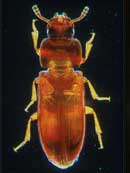
| Red flour beetle Tribolium castaneum | |
Tribolium castaneum, the red flour beetle, is a basal holometabolous insect and representative of the most species rich animal taxon on earth - the beetles. For comparative purposes, it holds a crucial position between the ancestral hemimetabolous and the most derived holometabolous insects. In contrast to the fly Drosophila, Tribolium displays more "typical" modes of development in several respects: posterior segments are formed one after the other from a posterior growth zone, the embryo develops appendages directly (and not via leg discs) and the larval head develops appendages (in contrast to the extremely derived head morphology of the Drosophila larva). As a pest of stored grain Tribolium has also received attention in pesticide resistance research.
Tribolium castaneum - a convenient model system
Tribolium is easy to rear in large amounts, constantly produces offspring and is amenable to various histological and molecular manipulations: Gene function can be knocked out by an extremely efficient RNAi response.
Furthermore, we have shown that injecting females with double stranded RNA knocks down gene function in the offspring (parental RNAi). This allows for the study of gene expression or application of standard histological methods to large amounts of knock-down embryos that have not been hurt by injection. In addition, transgenes can easily be introduced to the beetle genome using the piggyBac, Mariner or Minos transposons using a marker system that is widely applicable within the animal kingdom. A screen for EMS induced mutations has been carried out as well as initial insertional mutagenesis. The genomic sequence of Tribolium has been published in 2008. Genome editing via CRISPR/Cas9 is well established and opens up new opportunities.
 Importantly, Tribolium has become an extremely efficient platform for genome wide screening. This allows to overcome the prevailing candidate gene approach and opens new fields of research. Tribolium.
This "tool set" for Tribolium research will make it possible to deeply understand developmental processes in a "typical" holometabolous insect and will allow comparisions of Tribolium and Drosophila genetics to quite some depth. Importantly, processes that cannot be studied in Drosophila can be investigated using the red flour beetle.